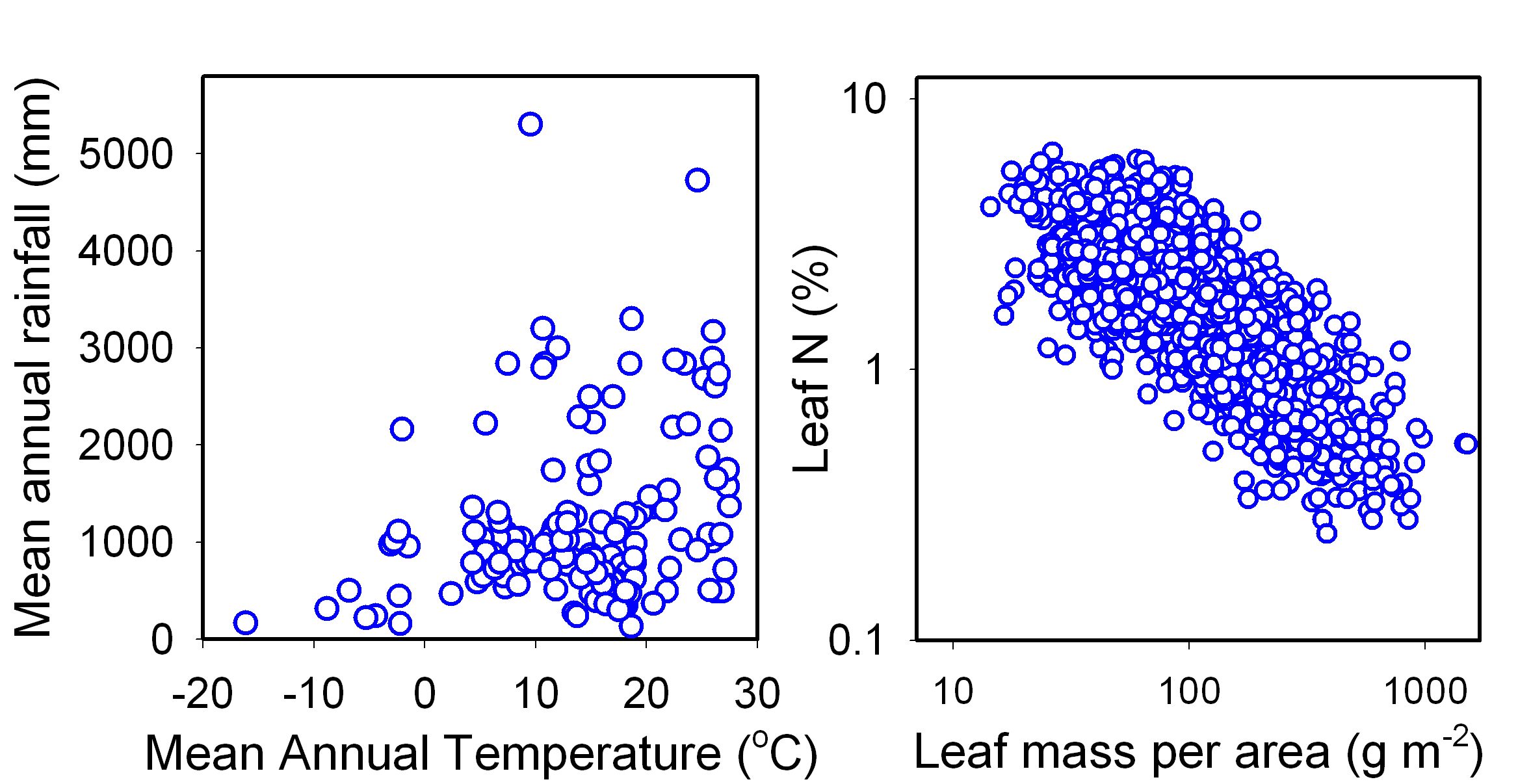
The project is open-ended. At this stage we have concentrated on collecting leaf trait data for field-grown plants. As of January 2004 the dataset comprised data for 2548 species from 175 sites around the world representing every major biome. Well represented traits include leaf mass per area (or its inverse, specific leaf area), leaf lifespan, leaf thickness and tissue density, leaf size, gas exchange traits (photosynthetic capacity, dark respiration, stomatal conductance, CO2 drawdown) and nutrient concentrations (N, P, K).
The first publication from the project was published as an Article in Nature (Wright et al. 2004). In this paper we discussed relationships among a core set of these traits, describing the principal axis of multivariate trait variation as the world-wide "leaf economics spectrum". This spectrum runs from quick to slow return on investments of nutrients and dry mass in leaves, and operates largely independently of growth form, plant functional type or biome. Site climate was quantified in terms of rainfall, temperature, VPD, potential evapotranspiration and irradiance. Overall, modulation of leaf trait relationships by climate was modest, although some striking and significant patterns were seen. In particular, a number of trends were identified which together appear to constitute a common syndrome for dealing with heat, aridity and irradiance stress.
In subsequent papers (see below) we have extended these analyses to other traits such as leaf K, leaf N:P ratios and photosynthetic N-use efficiency (PNUE). We have also examined the effect of climate on traits and trait relationships in more detail, recently extending these analyses to consider how leaf respiration in woody species varies with climate at the global scale.
Reliable quantification of these trait relationships and their interaction with climate will prove valuable for modelling nutrient fluxes and vegetation boundaries under changing land-use and climate. Exciting challenges for the future include quantifying the extent to which the leaf economics spectrum is orthogonal or parallel to variation in traits such as stem hydraulics, wood density or biomass allocation, and how it relates to whole-plant, stand and ecosystem properties. In recent collaborative projects data from glopnet is being used to improve parameterisation of new generation .
GLOPNET has provided the nucleus for numerous subsequent projects, tackling at global scale an increasingly diverse range of topics including shade & drought tolerance,
whole-plant respiration, N-P stoichiometry, litter decomposition, and incorporation of GLOPNET scaling equations into next-generation vegetation-climate models,
especially Dynamic Global Vegetation Models (DGVMs). Several research-strands making use of GLOPNET data were highlighted in a News Feature published in Nature (Whitfield, J. 2006. The cost of leafing.
Nature 444, 539-541).
GLOPNET publications
Reich PB, Wright IJ & Lusk CH (2007). Predicting leaf physiology from simple plant and climate attributes: A global GLOPNET analysis. Ecol Appl, 17, 1982-1988.
Shipley B, Lechowicz MJ, Wright IJ, & Reich PB (2006) Fundamental tradeoffs generating the worldwide leaf economics spectrum. Ecology 87, 535-541.
Wright IJ, Reich PB, Atkin OK, Lusk CH, Tjoelker MG & Westoby M (2006). Irradiance, temperature and rainfall influence leaf respiration among woody species: evidence from comparisons across 20 sites. New Phytologist 169: 309-319. [pdf]
Wright IJ, Reich PB, Cornelissen JHC, Falster DS, Groom PK, Hikosaka K, Lee W, Lusk CH, Niinemets Ü, Oleksyn J, Osada N, Poorter H, Warton DI, & Westoby M (2005). Modulation of leaf economic traits and trait relationships by climate. Global Ecology & Biogeography 14: 411–421. [pdf]
Wright IJ, Reich PB, Cornelissen JHC, Falster DS, Garnier E, Hikosaka K, Lamont BB, Lee W, Oleksyn J, Osada N, Poorter H, Villar R, Warton DI & Westoby M (2005). Assessing the generality of global leaf trait relationships. New Phytologist 166: 485-496. [pdf]
Wright IJ, Reich PB, Westoby M, Ackerly DD, Baruch Z, Bongers F, Cavender-Bares J, Chapin FS, Cornelissen JHC, Diemer M, Flexas J, Garnier E, Groom PK, Gulias J, Hikosaka K, Lamont BB, Lee T, Lee W, Lusk C, Midgley JJ, Navas M-L, Niinemets Ü, Oleksyn J, Osada N, Poorter H, Poot P, Prior L, Pyankov VI, Roumet C, Thomas SC, Tjoelker MG, Veneklaas E & Villar R (2004). The world-wide leaf economics spectrum. Nature 428, 821-827. [pdf]
This paper made it on to the Essential Science Indicators list (July 2006, Environment & Ecology) of Top 3 papers published in the last 2 years, then having been cited 85 times. As of July 2009 the number of citations was > 400.
Some other GLOPNET-related articles include:
- Wright IJ & Westoby M (2004). The economics of leaves. Australasian Science 25, 34-38.
- Niklas KJ, Cobb ED, Niinemets U, Reich PB, Sellin A, Shipley B & Wright IJ (2007). "Diminishing returns" in the scaling of functional leaf traits across and within species groups. Proc Natl Acad Sci USA, 104, 8891-8896.
- Reich PB, Tjoelker MG, Pregitzer KS, Wright IJ, Oleksyn J & Machado J-L (2008). Scaling of respiration to nitrogen in leaves, stems and roots of higher land plants. Ecology Letters 11, 793-801.
- Hallik L, Niinemets Ü, Wright IJ (2009). Tolerance to shade and drought in relation to foliage structural and functional traits in temperate woody species. New Phytologist (in press).
- Ordonez J, Aerts R, van Bodegom P, Witte J-P, Wright IJ, Reich P. (2009). A global study of relationships between leaf traits, climate and soil measures of nutrient fertility. Global Ecology & Biogeography 18:137-149.
- Poorter H, Niinemets U, Poorter L, Wright IJ, Villar R (2009). Causes and consequences of variation in leaf mass per area (LMA): a meta-analysis. (Tansley review) New Phytologist 182:565-588.
- Reich PB, Oleksyn J, Wright IJ (2009). Leaf phosphorus influences the photosynthesis-nitrogen relation: a crossbiome analysis of 319 species. Oecologia, 160:207-212.
GLOPNET. Left panel: Mean
annual rainfall and mean annual temperature for the 175 sites from where GLOPNET data were compiled. Right panel: Leaf N concentration versus leaf mass per area (r2 = 0.57; data for 1958 species)