



Home People

Phylogenetics, Phylogeography and Conservation Genetics
of Wobbegong Sharks

Coordinator
Dr Luciano Beheregaray

PhD student
Shannon Corrigan

Collaborators
Charles Huveneers
Tonia Schwartz
Dr Vic Peddemors
Dr Robert Harcourt

Financial and logistic support

How you can help this study
(click here)

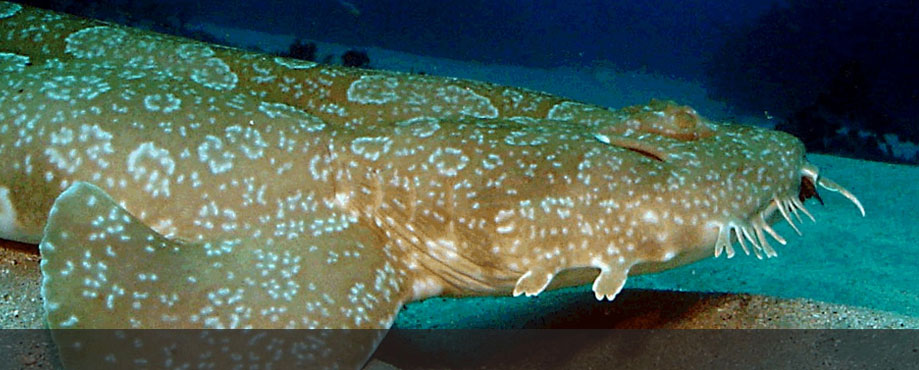
Wobbegongs (Orectolobidae) are inshore benthic sharks inhabiting continental shelves of the southwest Pacific. The family Orectolobidae consists of seven species, six of which are found in Australian waters. However, much taxonomic uncertainty surrounds the group and several new species descriptions and redescriptions are currently being undertaken.

Wobbegongs are harvested in Australian ocean trap and line fisheries popular for their marketable flesh, often being sold under misleading market names such as ‘flake’. Common elasmobranch life history characteristics such as slow growth rate, late onset maturity and low fecundity, may render wobbegongs particularly susceptible to stock depletion through over fishing. Predominantly targeted in NSW, commercial landings of wobbegong sharks have declined by more than 60% since 1990 (NSW Fisheries unpublished data). As a result, in 2003 wobbegongs distributed throughout NSW were classified at the IUCN shark specialist group Australia and Oceania regional redlist workshop as vulnerable in NSW and near-threatened throughout their range in. In 2004, these species were again highlighted in the National Plan of Action for the Conservation of Sharks, Skates and Rays as being of “particular concern”. Despite this, fishing of Orectolobids remains unmanaged.

In this project we are conducting an assessment of the evolutionary history and the population genetic structure of wobbegong sharks in Australia and in the Indo-Pacific. We are using modern DNA approaches to:

– Address taxonomic uncertainty through a phylogenetic review of the family.

- Elucidate historical and current patterns of population genetic structure of wobbegong sharks.

– Identify mechanisms causing population structure in these sharks (i.e. differences in the dispersal rates between sexes).

- Investigate the breeding system of these animals.

– Identify conservation units and propose management strategies. This will be done by combining genetic outcomes with life-history and fisheries data.

In addition to the spotted and ornate wobbegongs a “dwarf” morphotype that matures at a smaller size than the other species has been identified along the NSW coast. We have tested for reproductive isolation among sympatric morphotypes using DNA methods and in combination with data on reproductive biology have confirmed that the dwarf form represents a distinct species (paper in preparation, see media releases). This finding has direct implications for monitoring commercial catches and establishing conservation strategies for wobbegongs.


How you can help this study

We need tissue samples of wobbegong sharks from around Australia and from the Indo-Pacific to understand patterns of migration and population structure over larger geographic scales. If you have access to a dead wobbegong shark please store a small piece of its flesh in a freezer or in ethanol and consult Shannon Corrigan. She can then arrange the best way for you to send us the sample (we will pay for shipping).


Click here for photographs of our field expeditions

Selected publications

- Corrigan S, Huveneers C, Schwartz TS, Harcourt R, Beheregaray LB (in review) Genetic and reproductive evidence for a cryptic species of wobbegong shark on the Australian east coast.


Designed by Rekha Joshi and Luciano Beheregaray